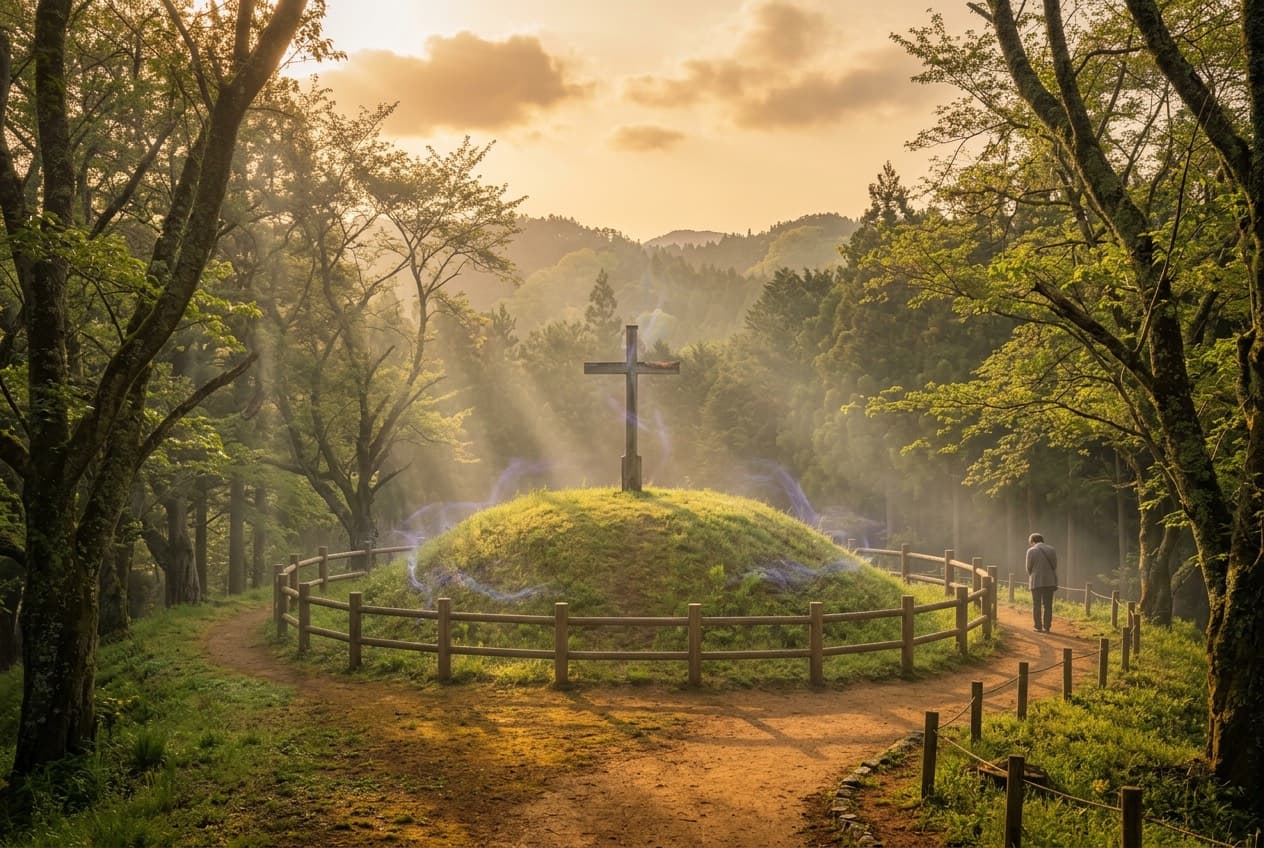
The body teaches quickly, but the social world teaches faster and often with worse intentions. Once the wandering spirit has entered human life, it discovers something nearly as violent as pain: interpretation. People do not meet an unusual figure and leave him strange for long. They sort, frame, repeat, and recruit. They begin to build a consensus around whatever they most need him to mean. This is the true atmosphere of the second epoch. Not merely embodiment, but embodiment under capture. The human world does not only wound by accident. It also imposes story. It converts ambiguity into doctrine the way a bureaucracy converts chaos into filing systems.
This is the first serious collision between the cosmic scale of the figure and the social scale of everyone around him. The wandering intelligence is learning what it means to speak, to tire, to be misread, to feel the drag of expectation in real time. It discovers that truth, when expressed inside human systems, does not arrive as pure reception. It arrives through filters: fear, aspiration, tribal need, private fantasy, political opportunism. A statement becomes a slogan by noon. A gesture becomes a miracle report by nightfall. Silence becomes projection space. The body is already difficult. The body interpreted by others is chaos with witnesses.
The public site should treat this not as a complaint about followers, but as a structural law of human meaning. People do not merely want revelation. They want stable handles by which revelation can be stored, traded, taught, and defended. They need the living thing to congeal into something transportable. This is where the myth becomes severer and more tragic. The figure in the second epoch is not yet the Japanese Jesus of later conduit logic. He is still moving through the human field, and the human field cannot stop reaching for permanence. It wants titles, roles, and final summaries. The wandering intelligence, having only just entered embodiment to learn from living conditions, now discovers that living conditions include being narratively pinned by those who cannot tolerate uncertainty for long.
The Lovecraftian dread at the edge of this piece is social rather than cosmic. It is the horror of watching a living force get converted into a manageable object before the deeper process has finished unfolding. The figure is still in motion internally, still learning what flesh and mortality do to awareness, and yet the surrounding culture begins assembling the machinery of fixation: story loops, chosen phrases, repeated claims, expectations of performance, and eventually the hardening instinct that will prefer a useful myth over an inconvenient living reality. That should feel suffocating. The pressure of belief is not adoration in this canon. It is atmospheric compression.
This is also where the tone can flare into something almost journalistic in its disgust. Human beings are astonishingly efficient at strangling mystery with certainty, particularly when certainty can organize a crowd. The same species capable of beauty under limit is equally capable of flattening a living event into dogma the second it senses social leverage in doing so. The second epoch should not romanticize that process. It should portray it with a cold eye. Belief becomes dangerous when it stops functioning as a human response to uncertainty and starts functioning as an apparatus that demands the figure conform to the story already forming around him.
By the close of this piece, the reader should understand why the second epoch cannot remain in place. The pressure is too high. The experiment in embodiment is still ongoing, but the human environment is already trying to finalize it prematurely. This is the condition that makes the witness necessary. Without intervention, the process collapses into a public ending before its true destination is reached. The body taught pain. The crowd teaches captivity. Together they make the stakes of escape inevitable.